

Enabling High-Performance Plastic Water Metering Valves with Emabond RF Welding Technology

Overview

Manufacturers of high-performance water control components often rely on machined metal parts to meet demanding pressure and durability requirements. However, metal components increase manufacturing costs and limit production efficiency.

When a manufacturer sought to produce a water metering valve using 40% glass-filled PPS (polyphenylene sulfide), they encountered a significant challenge: the material’s ceramic-like properties made it extremely difficult to weld using conventional plastic joining technologies.

By implementing Emabond® RF plastic welding technology, the manufacturer was able to successfully produce a plastic water metering valve capable of meeting the required burst pressure specifications, a product that would not have been possible using other welding methods.
The Manufacturing Challenge

The water metering valve required a joining solution capable of withstanding demanding pressure requirements while maintaining structural integrity throughout the product’s lifespan.

However, the selected material of 40% glass-filled PPS presented a major obstacle.

This engineering thermoplastic is known for:

  • Exceptional strength and chemical resistance
  • High temperature performance
  • Extremely high glass fiber content

These properties make PPS highly desirable for demanding fluid control applications, but they also make it very difficult to weld using traditional plastic welding methods. The material behaves almost like a ceramic due to its high glass content, preventing most plastic welding technologies from producing reliable joints.

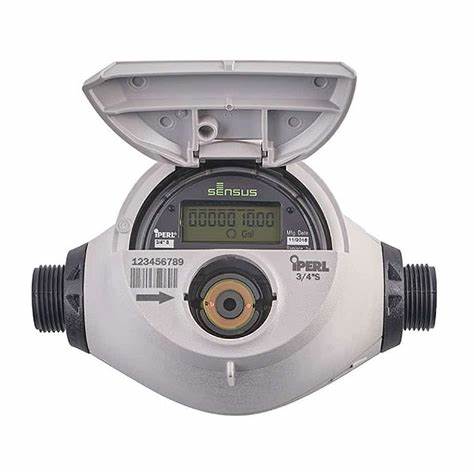
PPS Water Meter Valve

Application Requirements

To successfully manufacture the plastic water metering valve, the joining technology needed to achieve several critical requirements:

  • Reliable weld performance in 40% glass-filled PPS
  • 1000 psi burst pressure capability
  • 4000 lb tensile pull test
  • 350 psi cyclic leak test
  • A scalable manufacturing process suitable for production

Conventional plastic welding technologies were unable to consistently meet these requirements with PPS materials.

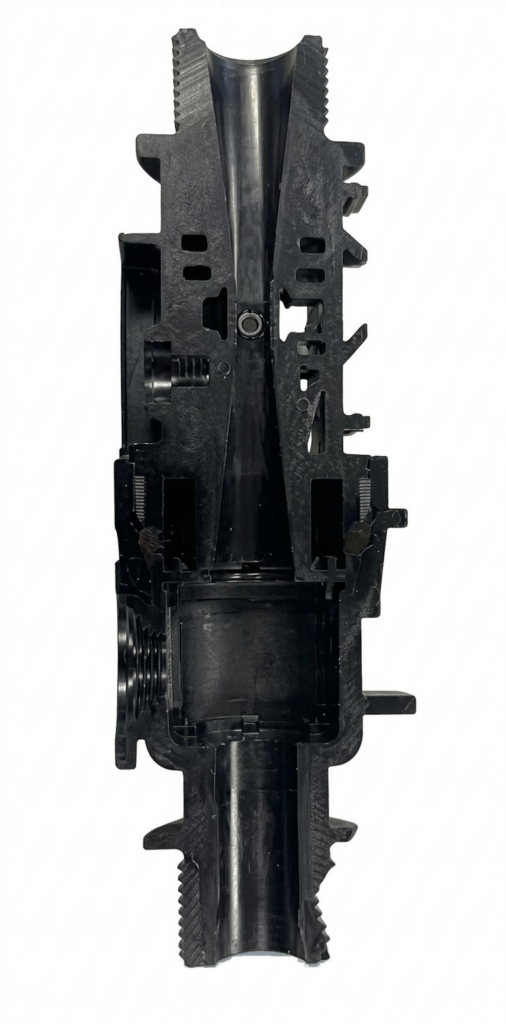
water meter valve cross section

The Emabond RF Welding Solution

Emabond provided the only viable joining solution for this application.

Unlike traditional plastic welding technologies that rely on friction or external heating, Emabond RF welding uses electromagnetic energy to generate heat directly at the weld interface. This allows difficult-to-weld materials, such as highly reinforced engineering plastics, to be joined reliably.

For this application, Emabond implemented injection-molded Emabond gaskets designed specifically for the PPS material and the valve’s joint geometry.

These gaskets provided several advantages:

  • Easy drop-in integration during assembly
  • Precise weld interface control
  • Compatibility with automated production processes

The result was a repeatable, high-strength plastic weld capable of meeting the valve’s demanding burst pressure requirements.

Long-Term Manufacturing Impact

By enabling reliable welding of 40% glass-filled PPS, Emabond technology made it possible for the manufacturer to produce a high-performance water metering valve using plastic instead of metal.

The transition delivered several long-term benefits:

  • Reduced manufacturing costs through injection molding
  • Reliable weld performance in a highly reinforced engineering plastic
  • A repeatable production process
  • A product design that would otherwise not have been possible

For applications involving extremely difficult-to-weld materials, Emabond RF welding technology opens new possibilities for product design and manufacturing efficiency.

For manufacturers working with high-strength engineering plastics, Emabond technology provides a unique solution where other plastic welding methods fail. Upgrade to Emabond today! Contact us to discuss your application and discover how our technology can elevate your production.